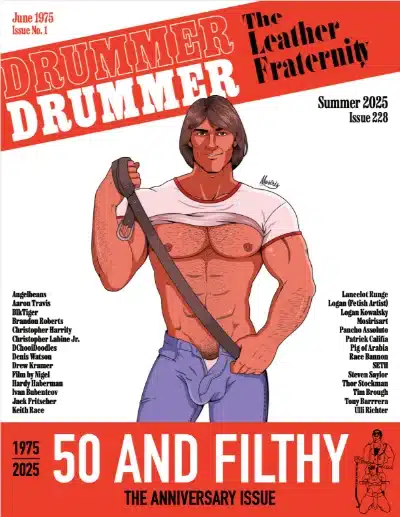
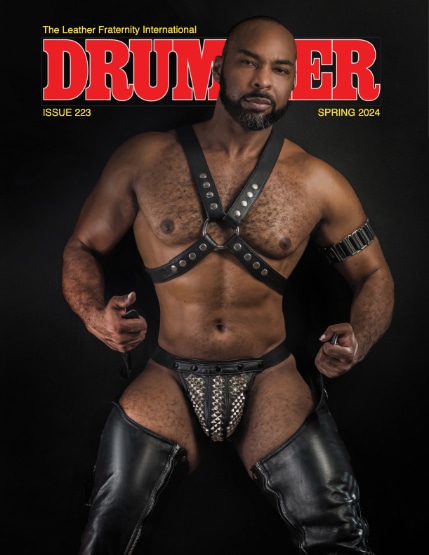

It’s important for people to know about the sacrifices made to preserve DRUMMER’s legacy. One of many who make those sacrifices, its publisher, Jack MacCullum, is not one to step into the spotlight or seek recognition –– it took considerable effort to convince him to even sit for an interview. In his own words– “I don’t like the acknowledgement or the praise. I’m not that kind of person – it makes me feel weird. I do this for us – for all of us.”
Protest aside, his contributions to the leather and kink culture were too strong to ignore, and this story needed to be shared. The story of how, after 20 years silent, the drum beat again.
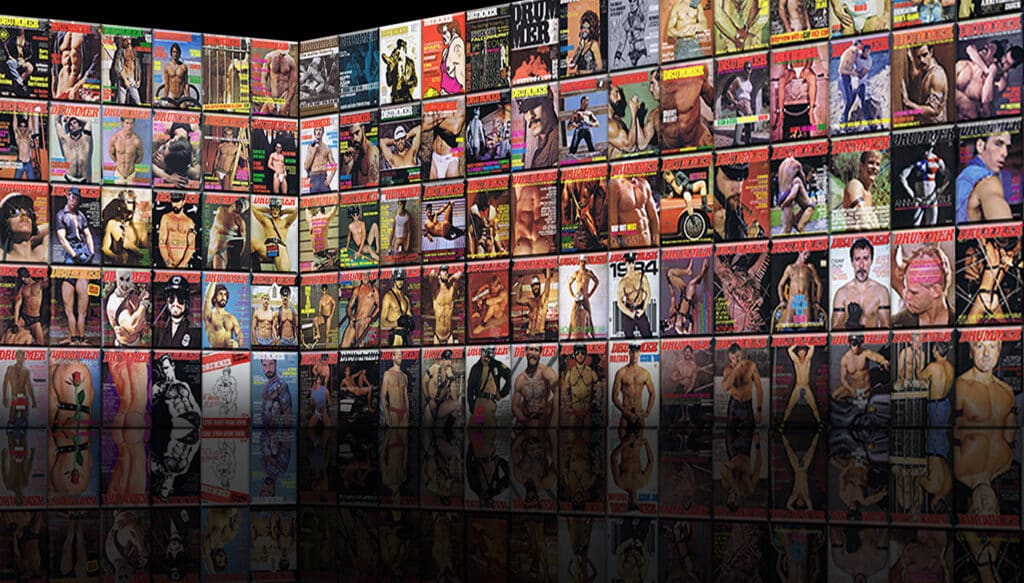
This article wasn’t something requested or paid to be written. I already have a great role being the Digital Director, helping to shepherd the brand onto a more accessible platform, most significantly, digitizing a library of the first 214 issues, now called “Origins.” This wasn’t just a technical project – it was transformative. As I explored those pages, I realized these issues weren’t just records of leather history; they were deeply connected to my own story. It reignited my passion for leather and gear in a profound way.
Picking Up The Torch
“One thing people don’t realize,” says Darkqwolf, Editor in Chief at Drummer, “is how passionate yet unassuming he is – which is the point. There’s so much he does that no one knows about – even with this. DRUMMER is a reflection of his heart.” The work isn’t about personal ego; it’s about stewarding a legacy and fostering a continued space for fetish, both at home and abroad. He continues, “Early on I asked him why he brought it back – his response: ‘to take care of it.’ That tells you all you need to know.” To hear Jack tell it himself– “I really had no plans to bring the publication back, it just fell into place.” Reflecting further he told me “I just didn’t want the DRUMMER name to be in the hands of the wrong people. Somebody had to do something.”
And so, he did.
___
For decades, DRUMMER has been a cultural touchstone for the leather and BDSM scenes. After two decades dark, what exactly made him bring it back? Why? How?
He tells us- “Personally I feel we have such a lack of mentorship. To give you some backstory, how this all came about was, DNA (Drummer North America), who I was a titleholder for, collapsed. During that time period, the owner or the founder kept saying that “this was Drummer magazine.” And I’m like, ‘there’s something not quite right about this.’
“I did some research and found out who the last owner of Drummer was, which was Martijn Bakker, who owns RoB in Amsterdam. So I reached out to his partner, Martin, and come to find out, they never sold anything. They never loaned or leased anything. The contest was leased for [only] two years, from 1999 to 2001. I said to him, “Listen, I just feel like the name itself is worth something. Whether I bring it back in a publication or what I do with it, does it matter?” And he’s like, “Absolutely not.” I flew over during Amsterdam Leather Pride in October of 2018, we sat down and hashed out an agreement that I would take ownership of Drummer magazine––DRUMMER and everything that involves DRUMMER including the titles, because I personally never wanted a title to be associated with Drummer magazine again. With the controversy surrounding DNA and everything else, I didn’t want this to be about any drama. For as long as I live and as long as I own DRUMMER, I never want to have it associated with a title. Ever.
“That being said, I came back to the United States after purchasing it from Martijn. Got the whole stories and everything – we’ll sit down and talk about them at some point because they’re actually quite interesting. When he bought it, like me, he had no idea. He [had] never published a magazine, never knew really about any of that. He ran a leather store – that was his deal. Somebody convinced him to buy it and it turned into a big disaster. Couldn’t find a printing company. Come to find out when he bought it, the IRS, he owed them $100,000 in back taxes because when you buy a company, everything moves with that.
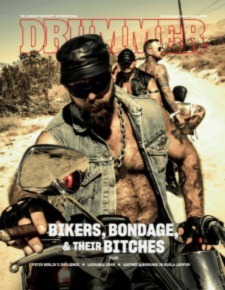
“I came back to the United States and sat down with Jack Fritscher. I said, “Listen, I’m not sure if I want to do a publication, whether I just want to hold this or whatever.” But then I thought about it and I said “You know, I think that there’s a magazine out there. I think that we could do a print and a digital magazine and what do you think about being the editor for it?” He was like ‘at this age I don’t have it in me to be an editor…but I do have a couple of people I have in mind’, and that’s where I got Mike Miksche. I learned a lot under him. Although I was the publisher, he was the editor––I learned kind of about…what goes on. I had never done this before… So, it was a learning experience. I learned what not to do and what to do.
“When Mike came on board it was a lot of back and forth. He came for a week and we collaborated together about the first issue. And honestly, when we put together that first issue, I was just like, “This is phenomenal. This is great.” Because he knew what he was doing, and I was along for the ride and it was terrific. I feel like that first issue we blew it out of the water, meaning people…there was so much chatter around DRUMMER coming back that I was like “this is amazing.” Now, getting them to hold on after the pandemic has been a challenge but for all intents and purposes I think we’re doing it right. I mean, from what I see, we’re doing it right. We’re ethical, we’re logical, and we have integrity, and that’s all that matters to me. That’s the core for all of my businesses – anything else that I’ve done is [done with] integrity. I don’t ever want to be known to screw anybody.”
Keeping It Lit
Bringing DRUMMER back was not just about nostalgia or prestige. It stemmed from something deeper – a belief that the stories, art, and voices of the leather and kink subcultures deserved space on the world stage. That it could be a loud and proud megaphone for self-expression in a world often determined to silence queer histories or fetish cultures. Beyond that though, he feels there’s something more.
“The thing that I really felt that DRUMMER addressed before and we continue to address, are those guys that are in Des Moines or Bumfuck, Nowhere…..the Outback. There are people in places that have no access to anyone for miles around that share their same ideas and their same kinks or fetishes––we are an outlet for them. I feel like that’s what we are, that’s what we do. We’re not just for the guys in the big cities. We’re for the little guys in Morgantown, West Virginia and wherever. Those places need it more than, I think, New York. Because you walk down the street in New York, you can usually find a guy that can be into the same things that you are. You have more of an outlet. The guys in those other places, there’s no one and they can’t always move to a big city like San Francisco or Los Angeles or Chicago or New York or wherever. Sometimes, it’s familiar commitments. Sometimes it’s economic. It could be that they’re married to a woman, they’re straight [and] in a relationship and they can’t leave. It could be anything. Whatever it is. But the thing that I’ve always felt, that DRUMMER has always meant to me is, it’s kind of a cohesion of men. It’s a fraternity and it always has been, and it always will be a fraternity of like-minded men.”
Honoring the Past, Building the Future
“Drummer Magazine was and still is today a trailblazing publication,” says Race Bannon, noted author, activist, speaker, educator. “It sustains as an iconic community touchstone because of Jack MacCullum who has dedicated his resources, time, and energy to resurrecting and publishing one of our community’s most vital legacy magazines. Drummer continues to celebrate sexualities, identities, and lifestyles that honor the past while also looking ahead to the contemporary leather and kink future.”
The vision for DRUMMER isn’t merely to acknowledge its historic relevance but to transform it into a blueprint for what the leather and BDSM scene can become next. Although Jack would disagree to great extent. “No…no, no, no. I am not that person –– I do not dictate anything to anyone.” To Darkqwolf he says, “This is our vision because you’re the editor and I’m the publisher and we have so many people from around the world contributing to us. This is our vision. Whatever you [in general] make of it, that’s yours! You’re free to create or continue or whatever you want to do to make this scene yours. For all intents and purposes, what Drummer Magazine is giving you is what we think is hot. Doesn’t mean that just because we think it’s hot, it is hot. But for us it is. But I’m not trying to dictate anything.”
So how does he ensure that the publication’s principles – freedom of expression, pride in identity, and rejection of bigotry – remain at its core while modernizing it? Strong editorial trust. “You [Darkqwolf] and I both have a really good relationship, I feel. I trust you implicitly when it comes to actually making the calls. I mean, if I didn’t, I would be micromanaging and I’m not a micromanager. By the same token, if there’s something that’s wrong, I’ll let you know or say ‘not so crazy about that…’. But I can’t say that there’s any single thing that I do….I mean all that rests on your shoulders. That’s not me. What you’re bringing, the content that you’re bringing, that’s what’s guaranteeing the legacy of DRUMMER Magazine.” Again, he’s humble in neglecting to admit that his vision is very strong, clear and meaningful – making the calls more easily made and the weight on those shoulders, lighter.
____
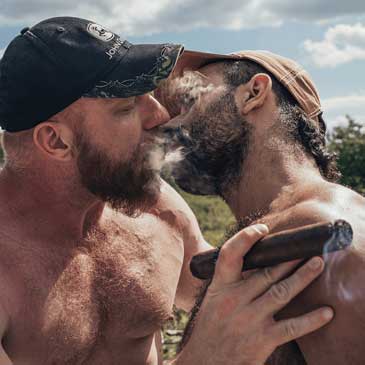
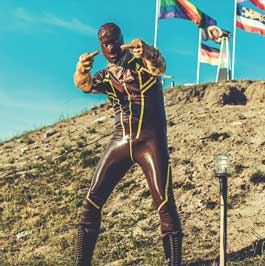
The DRUMMER philosophy of freedom continues into the contemporary era, emphasizing inclusivity at every turn. It now embraces a broader spectrum of sexual expression, celebrating everything from Bears and Masters/slaves, to Truckers, Punks, Cowboys, Superheroes and the renewed popularity of rubber and gear fetishes. Knowing how intentional he’s been since the outset, I asked why this mission was so important. “I feel like the original DRUMMER didn’t have that. It (diversity) was not part of that. If you were not white and you didn’t have a great body…. My inclusivity thing is that I do want DRUMMER to be a place where whether you’re Black, white, Asian, Latino – I don’t care. I want you to be as kinky and as leather-centric as you want, as you can. That’s important to me. That’s absolutely important to me and I want everyone to feel like they have a place here.”
A Quiet Force
An ability to work without ego, his focus entirely on the scene he’s been part of for years, Boy Nikko describes this with perspective and reverence: “Jack is one of those few key people who actually make the LFK (Leather, Fetish & Kink) scene work for everyone, everywhere. Without asking for anything in return and indeed whilst actively avoiding the limelight, he puts his time and his wallet into the service of keeping one of the truly great institutions of not just the LFK scene, but for the whole LGBTQI+ community a living, breathing part of today that is just as relevant now as it was when it started 50 years ago.”
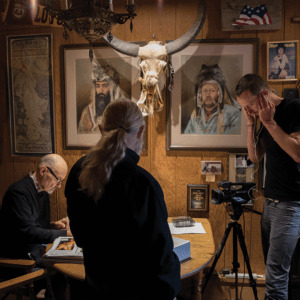
It goes beyond publishing. Ulli Richter, a celebrated photographer and contributor to several issues, shares, “Drummer has been a cornerstone of the masculine leather scene for five decades, and Jack has played an invaluable role in supporting the KinkFetish arts. His dedication has been crucial – helping [us] to organize shoots, create films, and craft stories that wouldn’t exist without the support of passionate individuals like him.”
DRUMMER embodies every principle of connection, advocacy, and passion that stands for. Through work and resilience, it has bridged generations of leathermen, ensuring that the magazine speaks to seasoned veterans and curious newcomers alike. Drummer is more than just a magazine – it’s a living, breathing testament to freedom.
Again, he demurs.
“‘Freedom’ is not a word that I would use. I will say that from the beginning, I wanted to not only keep the subscribers that we have – which tend to skew older – but also bring in the younger crowd. Because that older crowd has that nostalgia. The younger crowd doesn’t even know about it [the DRUMMER legacy] for the most part. So that’s part of the reason why I wanted to bridge those two. But to say “freedom”…. I would just say that I want to ensure that men are proud of who they are. Not the ‘freedom’ side of it – it’s like more or less being proud of who you are.”
Leadership Rooted In A Vision
Leadership is not of the spotlight; instead, it’s grounded in a definitive purpose. “It has been a truly rewarding experience meeting Jack and his passionate team,” shares Adrian Bernal of Rough Trade Gear. “Under his leadership, the DRUMMER brand continues to uphold its core values with unwavering strength and authenticity.” And if you ask Jack what are those core values? He jokes, “Listen, I’m not going to say ‘safe, sane, and consensual’ because I am not safe, I am not sane and I am not consensual.
Author: Scott Tambling and Darkqwolf