


Old Town was home to many gay men at the time. Along with the Glory Hole, nearby was Our Den and the iconic gay adult film venue the Bijou, which was the longest running gay theater in the United States until closing in September 2015. A relatively short walk from where I lived was my home leather bar and the place that formed me as a leatherman more than any other, the Gold Coast, one of the first American leather bars.
Not surprisingly my gay sex and social life were rather wonderful and filled with any form of play I might want including the kinky variety. That was a hyper-sexual period for me that I’ll never forget. It was formative. Next door to where I lived above the Glory Hole bar was a 24-hour adult bookstore, Over 21, that at the time claimed to be the busiest gay adult bookstore in the country. It sure seems that was the case by how popular it was. It would be a massive understatement to say I had a lot of sex in the back of that establishment. The world’s busiest gay adult bookstore with an active backroom was a mere few feet from my apartment’s front door. It was pig heaven, and I took advantage of it often.
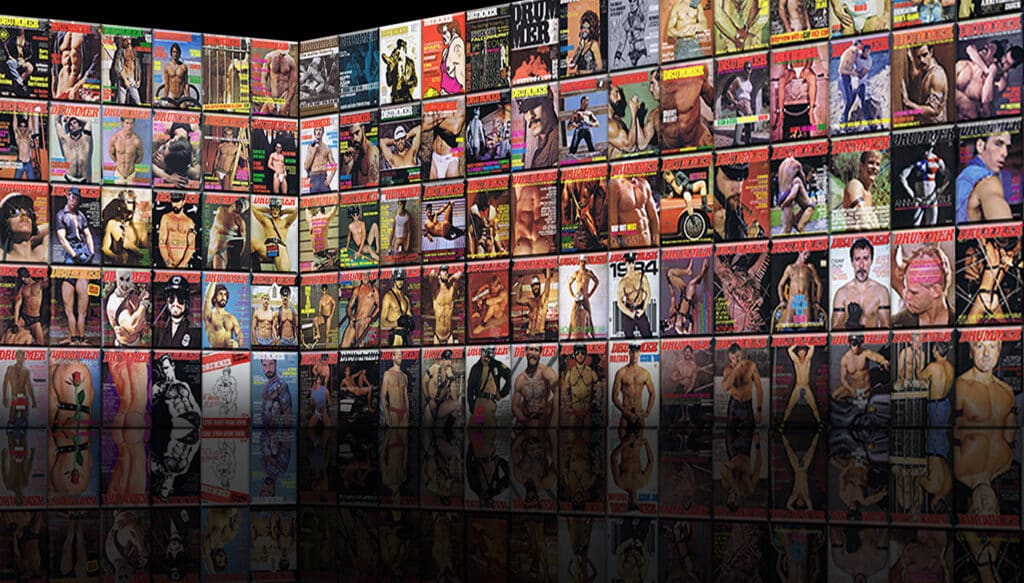
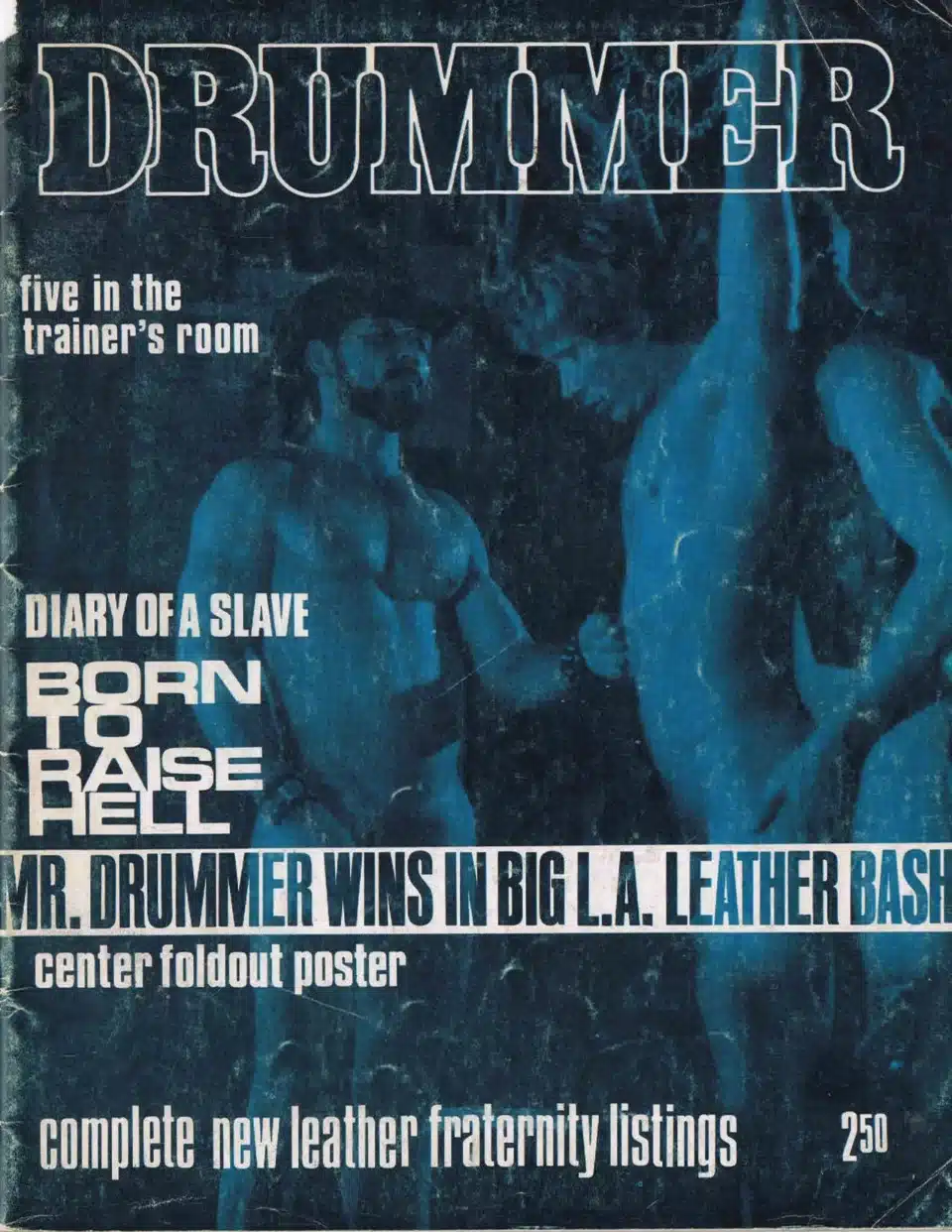
One day as I was perusing the bookstore’s shelves, I caught a glimpse of the third issue of Drummer Magazine, a magazine I had not seen prior. The cover included a photo from a hot BDSM porn movie at the time, Born to Raise Hell. Needless to say, I immediately bought it. That night and the next day I read the magazine cover to cover. It felt so good to read and see my actual leather life reflected in print. One of the things publications can do is validate and elevate their target demographic. That’s what Drummer did for me and what I think it did for most gay leathermen who read it. Here was my day-to-day kinky life openly discussed in a high-quality magazine. Wow.
I bought every issue of Drummer from that point forward. Even when I was barely scraping by financially, I’d make sure to set aside a few bucks to buy a copy. Most of my social circle of leather brothers bought and read it too. It became a central cultural discussion point among my leather peers. Why?
Certain elements of a culture end up becoming ubiquitous touchpoints that can bond a community more tightly. That’s what Drummer did for me and others. Sure, we were doing this thing called leather and leathersex long before Drummer emerged, but now we could hold in our hands something tangible that connected us all in an important way.
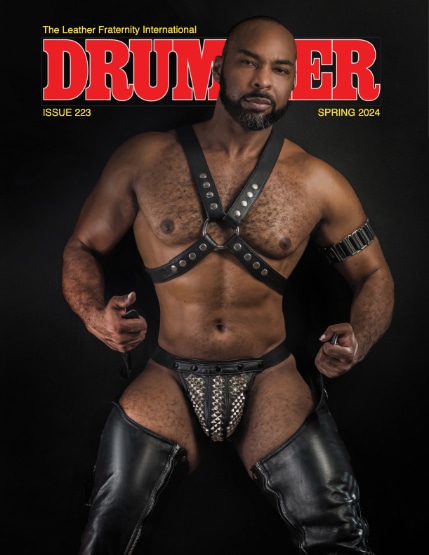
Drummer was (and is) a trailblazing publication. There’s no doubt about that. But apart from its important status as documentation of our leather world, it also inspires both newcomers and longtimers in our scene. Drummer serves many purposes within the gay men’s leather experience. That’s why to this day the mere mention of Drummer Magazine evokes immediate recollections of a bygone era that formed the foundation for the wide swath of modern gay men’s leather and kink communities. This new iteration of Drummer has resurrected that bygone era and transformed and morphed the magazine to reflect how current leathermen and kinksters live and play. It’s as relevant today in its new form as the old Drummer was back in the day.
While Drummer Magazine was important to the formation of the modern gay men’s leather communities, today it serves the function of celebrating certain flavors and styles of leather, as well as kink sexuality, to support the current generation of kinksters. But let me talk about its formative impact on me and then I’ll get to why it’s so important today.
––––
When I picked up that Issue 3 of Drummer Magazine it provided a snapshot into the entirety of the leather world in which I was already deeply entrenched. Looking at that issue illustrates the breadth of topics the magazine touched upon which related directly to a leatherman’s life at the time. The Leather Fraternity promoted in the magazine provided the means by which kinky men across the country and globe could connect with others of like mind. Long before the internet or hookup apps, clever snail mail strategies like those utilized by The Leather Fraternity provided a mechanism through which we could connect and play with other men who also danced on the edges of sexuality. I was living in Chicago, so the Illinois Fraternity listings were especially of interest. I frequented leather bars, bathhouses, and sex clubs, but sometimes men got the most honest about their kink needs in print. The Fraternity ads were a snapshot into the times then and educational for us today regarding how times have changed. One ad said:
“CHICAGO. M. Cancer. 31. 6’. 165. White. 6 1/2″. Knowledgeable. No role playing, wants the true S who enjoys seeing guy [sic] in pain and with bruises. Box 307.”
“M.” Guys into heavier kink often identified as masochist and sadist and abbreviated it with M and S. Today we’re much more likely to use the BDSM acronym to describe what we do and perhaps not be so rigidly tied to the M or S roles.
“Cancer.” Astrological signs were ubiquitous in personal ads back then and Drummer copied that format. I might have paid attention to this data point back then but today I would ignore it. Still, by copying the format used in more common personals ads, Drummer tied the radical sex we did to the tamer types of personals connections in other mainstream publications. That normalized to an extent our unique ways of identifying and playing.
“White.” Guys often listed their race, something we likely would not do today because it’s rightfully seen as a potentially racist signal. I don’t think most guys who did this were overtly racist, but merely listing one’s race as if it’s an important decision factor for hooking up elicits racist tropes we hopefully are moving away from today.
“Knowledgeable.” Back in the day, knowing who had skills, who was a poser, who was a newcomer but felt they had to project knowledge and skill to meet men, and who was potentially dangerous, was trickier than today. We couldn’t crosscheck their social media connections for common friends to consult or read detailed hookup app profiles and see accompanying photos like we can today. We still must be vigilant, but back then vetting someone was an often lengthier and complicated process.
“No role playing, wants the true S who enjoys seeing guy [sic] in pain and with bruises.” Even back then, this sentence would have been a red flag for me. “True S?” What does that mean? In those days there were men dedicated to a fantasy persona so rigidly, that they felt their way was the “true” way and only men like them were “real” players. Hopefully we’ve gotten past such thinking, but there are vestiges of this attitude that sadly linger.
“Box 307.” To connect with someone through a Leather Fraternity ad, you had to mail a letter to a specific Drummer address with the box number clearly listed. Once received, that letter would then be forwarded to the Fraternity personals advertiser with whom that box number was associated. They would get the letter and hopefully write back in a similar intermediated manner to the original party. My experience was that this process took approximately six weeks to complete. Six weeks. Compare that to the instant hookup apps of today. It was truly a different era.
Elsewhere in the same issue was an article discussing the truth, falsehoods, ins, and outs of fisting. At the time, there was little written about our style of sexuality and what was written was erotica, not informative or instructional. To see an article that attempted to give sound and informed advice about kinky sex was something readers like me craved and enthusiastically absorbed.
Drummer often contained erotica and Issue 3 had a hot locker room story that probably spawned many a copycat scene after men read it. It certainly stimulated my fantasy life, having spent lots of time in my youth competing in sports that landed me in locker rooms full of my naked peers.
An article about a live all-male erotic stage revue punctuates a time when one could only see such performances in real time.
The “MALECALL/Dear Sir” letters to the editor section of Drummer was always fun to read. One letter in Issue 3 read:
“I just wanted to drop you this note to let you know how pleased I am with the new DRUMMER. It’s a far cry from the old leaflets; keep up the good work!”
One should note that back then, men had to take pen to paper or clack away on a manual typewriter to send a letter to the editor. It took effort. Everything took more conscious effort. Such letters were reflective of many other men who felt similarly yet didn’t exert the effort to write.
Leaflets. Prior to Drummer, most gay men’s leather and kink content came in the form of what this writer calls leaflets. Drummer was different. It was a fully-fledged quality magazine that unabashedly heralded our sexuality and identity. I can’t emphasize enough how groundbreaking that was at the time.
Advertising throughout the magazine was one of the few ways guys could buy stuff to support their kink. Issue 3 illustrates the diversity of what Drummer advertised and was available to us at the time. Subscriptions to other gay men’s magazines. Collections of nude photographs, highlighting that most of the erotic content we consumed back then was words, photographs, and art. The Born to Raise Hell cover story advertised the photobook of stills, along with the 8mm film sold in four parts. A facial care product shows that even back then, gay men would spend money to look their best. An adult bookstore that also sold leather gear, because there weren’t many leather outlets to choose from back then. Gear and porn sold directly by the Drummer organization which helped their revenue stream. A few bars catering to leathermen. Only a single “sex hardware” shop, The Pleasure Chest Ltd., advertised because such places weren’t that common yet.
A “Body Buddy” section offered advice on fitness. The accompanying photo of a muscled man harkens to a time when massively muscled and chiseled men weren’t the norm even when touting fitness regimens.
Erotic art was a huge part of the leather scene back then. One layout was “Drawings by Bud.” That an erotic artist felt the need to be identified only by a single name evidenced a time when pseudonyms were more common in erotic art, writing, or in the creation of any sexual content.
A book review of Pumping Iron: The Art and Sport of Bodybuilding appealed to a leather subculture that worshipped the fit male body (which we still do today but our views of sexy body types have thankfully broadened considerably).
There was a lot more in those pages but I’ll leave my dissection of Issue 3 here. My point in listing all of that is to set the tone and background on how Drummer influenced me so profoundly.
–––
Despite frequenting a leather bar many times a week, when I first read Drummer Issue 3 and then every issue afterward it served to expand my own sexuality beyond simply what I experienced in my Chicago Gold Coast leather bar or the parties, sex clubs, and bathhouses that were abundant at the time. Drummer was entertainment, but it was also educational and inspirational. That was, for me, its core benefit. It documented the entire leather scene in ways that opened the sexual minds of men who only had their own real-time experiences to reference.
Drummer was, and I think still is today, a leathermen’s cultural linchpin. A linchpin is a core cohesive source of stability and security, or something critical to a system or organization. It’s one of the things Drummer provided the leathermen’s community and I contend still does in its current form. It sure did that for me in my early leatherman days. It serves as a common discussion point between men of like mind, much like a group socializing might discuss the latest hot television series they’re all watching. Cultural linchpins are extremely important. They serve as valuable bonding vehicles. Leathermen and gay kinksters around the world reference Drummer Magazine––both past and current iterations––constantly when chatting with their fellow sexual adventurers.
On an extremely personal note, I had strong ties to Drummer for many reasons. I had friends who worked there in various capacities including Editors such as Joseph Bean, Marcus-Jay Wonacott, and Tony DeBlase. These men and others associated with the magazine all ended up being close personal friends and were incredibly influential in my leather and kink life. I’ve never had an official mentor in the leather and kink scene, but when I’m pressed to name one, I always name Tony DeBlase. His intelligence, compassion, and character were incredibly influential at a time in my life when my leather profile and involvement was skyrocketing. Tony also remains to this day one of the best BDSM players I’ve ever had the honor of watching or playing with, and I still often evoke Tony in my mind when playing or navigating a personal or community issue asking myself, “What would Tony do here?” Many men who won the International Mr. Drummer contest became close friends, like Brian Dawson and Graylin Thornton. More than 30 years since our friendship began Graylin and I still do a regular podcast, “On Guard Cigar Salon,” with some other close friends. Other writers, artists, and business owners affiliated in some way with Drummer have influenced me or become friends because of that initial Drummer connection.
The magazine also served as an educational vehicle for me. Not having traveled the country or world much in my youth, I learned about leather life outside of my Chicago, New York City, and Los Angeles bubbles. One of the great contributions of the written word and imagery that documents a gay men’s culture such as leather is a sense of better knowing your fellow brethren. The more you know the “other” the more accepting and compassionate you become. I know some think Drummer enforced a type of uniformity in the community, but I contend it documented a uniformity that already existed. By putting it all in print the further expansion of that uniformity became more possible. Perhaps that would be a good study project for an anthropologist someday.
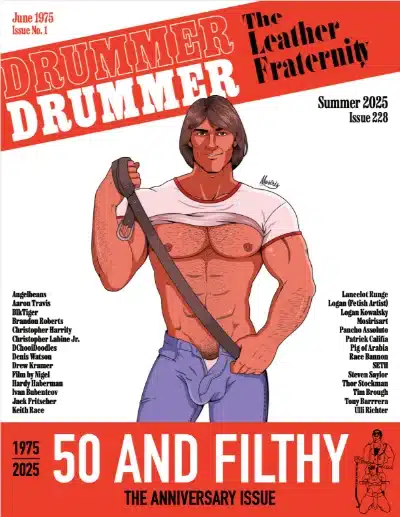
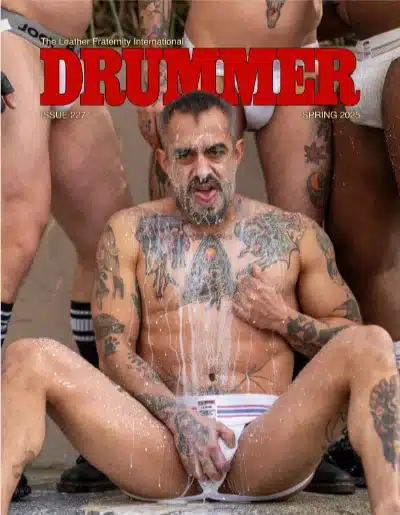
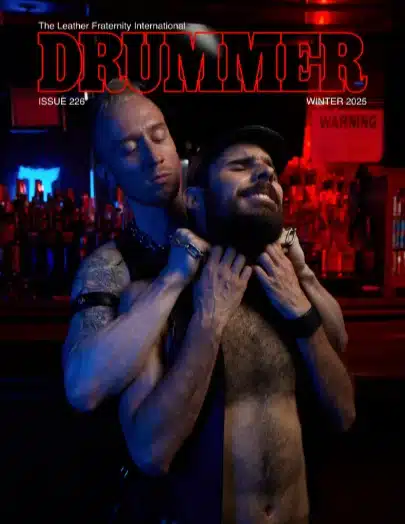
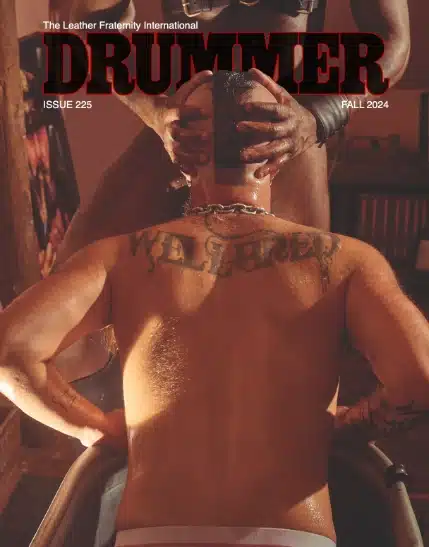
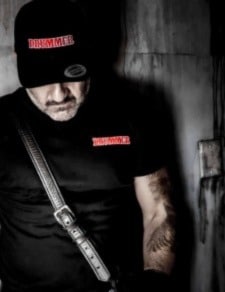
I could go on about the influence of Drummer Magazine Issues 1-214. At one time, I owned a copy of every single one of those issues and each had been read cover to cover, some more than once. It remained a foundational text for me to validate my leather existence, to learn about others like me, and to expand my mind, play, and identity to new horizons. But what about today’s new version? The version that publisher Jack MacCullum has resurrected from the ashes has created a more modern and relevant magazine that speaks directly to today’s gay leatherman, or to use a common contemporary identifier, kinkster. What Jack and his operational and editorial team have done is resurrect one of the most important gay leathermen’s cultural publications of all time and bring it into the modern era. They’ve done this without doing any dishonor whatsoever to the original publication. That’s quite a feat. This is why the modern iteration of Drummer is so important to me, as was the original. Between its pages Drummer continues to reflect the community of men it serves. Rather than idolize a single version of being a leatherman, Drummer has embraced the diversity that’s rightfully now part of our scene’s ethos. Elevating men of color, varying body types, a range of ages and styles, and kinks and fetishes that reflect how the leathermen and kinksters of today are playing, are just some of the ways Drummer remains truly relevant.
Drummer most certainly entertains. Frankly, that should be the first directive of any publication because if the written word and imagery amid it all doesn’t entertain, any other purpose gets lost. But Drummer does far more than entertain––it informs. It educates. It challenges. It gives voice to new ideas and perspectives. It doesn’t shy away from traditional topics while it simultaneously discusses new ones.
There are few things in the leather and kink world that stand the test of time. Drummer is thus far one of them for the men’s leather community. It provides a historical throughline by which readers can access an important legacy touchstone while still seeing the modern reflected back in its pages. That’s quite an accomplishment.
All of this points to why Drummer Magazine continues to be such an important part of my own leather and kink life, and why I believe it is for so many others as well. Oldtimers like me can revel in the past while looking to the future. Newcomers can appreciate the past while seeing their current identities and play represented. Few things in our scene do that––Drummer does. It has for 50 years. I hope it does for 50 more.
Author: Race Bannon
Photo Credit: DRUMMER Archives