
The Leather Fraternity
Story by: Jack Fritscher
Photography by: Courtesy of Jack Fritscher
October 2, 2019
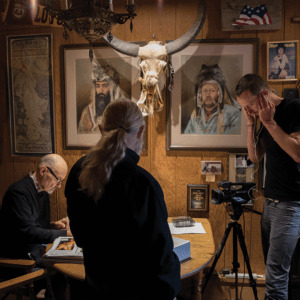
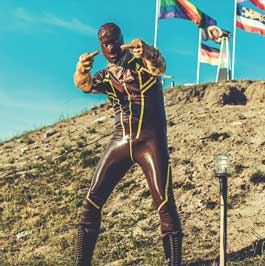
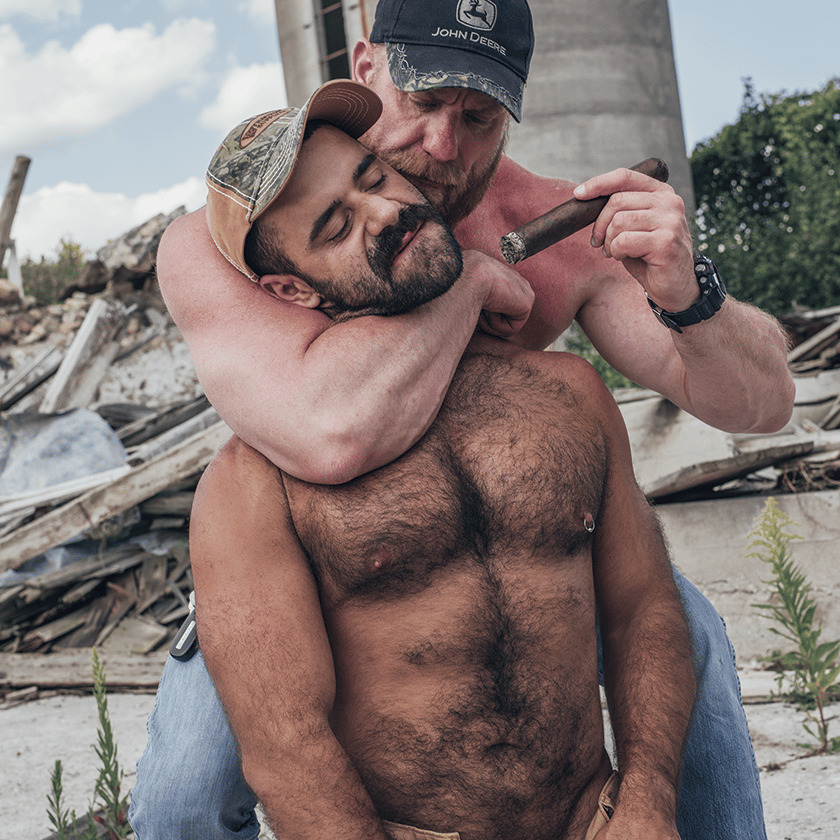
The guys at the S.F. Grapplers Wrestling Club give each other license to exert their force onto one another, while they practice all
forms of grappling like Brazilian Jiu-Jitsu (BJJ), submission grappling, and Western wrestling. Limbs get bent, and bodies are bound by each other’s hands, arms, and legs. In some cases, blokes are choked to submission but if things get too hairy, one can tap out, like a safe word, and the scene will stop just like that.
There seem to be no hard feelings after they “roll,” despite the brute force exerted at times. The guys act brotherly towards each other after, as though the battle has somehow brought them closer together. So what is it about a combat sport like grappling that strengthens these bonds?
Dave Ruechelle is one of the co-founders of S.F. Grapplers, which caters to bi, gay, and gay-friendly men in the Bay Area. He believes that “all men have some aggression that needs to be drained off somewhere.” Maybe this can begin to explain this fraternal phenomenon.
“It’s the chance to give each other permission to be aggressive; aggressive in the fight, and yet at the end of it or even during, learning from each other and cooperating,” he says. If Ruechelle gets one of his opponents to submit, he’ll offer to recreate the scene after it’s all over, while giving pointers.
“For me, that’s the brotherhood and fraternity aspect that I never had in my life,” he explains. “I never had that activity and that kind of camaraderie.”
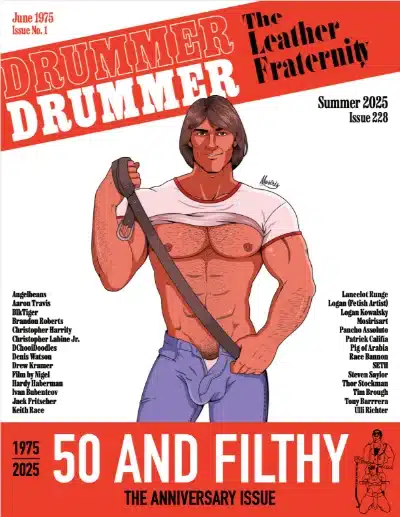
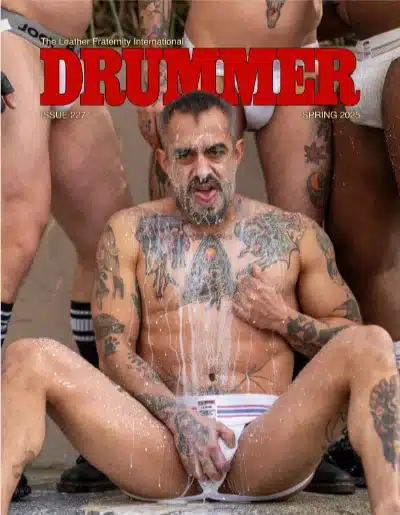
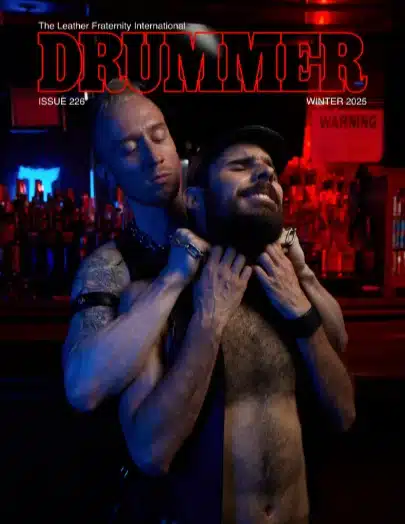
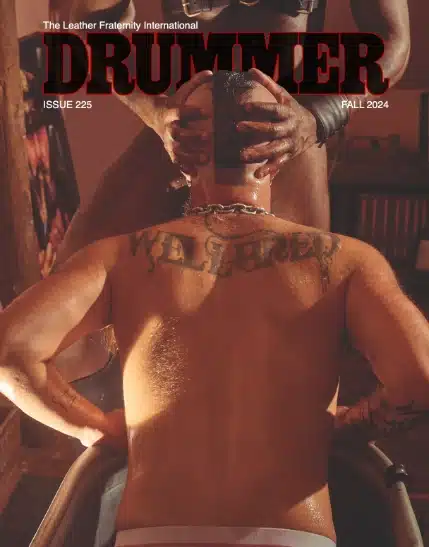
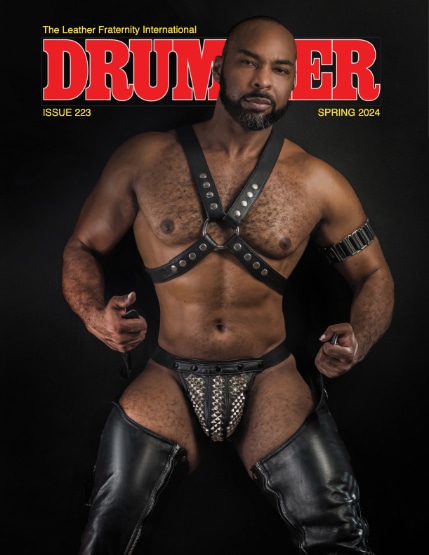
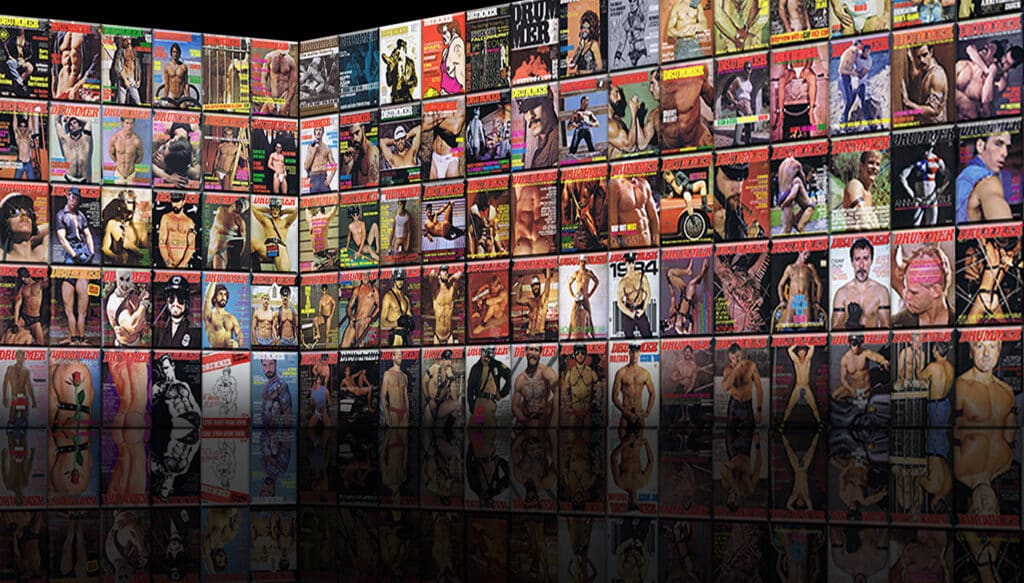
When a baroque-back cowboy from the 1970s heard Drummer was alive again, he asked what his complete collection of 214 issues was worth. I told him he had a priceless treasure chest of male leather history that shaped who we are today as a global Leather Fraternity. From 1975 to 1999, Drummer helped create the leather culture it reported on. It promoted leather-bar events and encouraged men to manifest their leather personalities in regional contests, leading up to the annual Mr. Drummer contest at the then quiet local Folsom Fair. Folsom exploded with international noise when Drummer began inviting global subscribers to fly in for the public-sex street orgy. Drummer helped thousands of leatherfolk come out. Facing the AIDS emergency, it rebranded itself under publisher Tony DeBlase, who created the Leather Flag, to make safe sex hot by outing new fetish role-playing, free of fluids. In 1977, kinky kismet got me hired as founding San Francisco editor-in-chief of this international juggernaut that was so epic in impact, it was bigger than any one of us, including publishers, editors, and contributors like Tom of Finland, Rex, Samuel Steward, Oscar Streaker Robert Opel, and my lover, Robert Mapplethorpe.
HOW WE DID WHAT WE’RE GOING TO DO
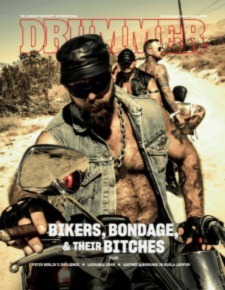
Drummer was a revolutionary idea in motion. As one of the first three slick magazines after Stonewall, it dared to portray our desires, to organize our thoughts, and to inform our practices. It was a first draft of leather history. This politically-incorrect “men’s adventure magazine” was the leather Bible that in the Titanic 1970s, before the iceberg of AIDS, brought the emerging gender of masculine-identified men out to claim a homomasculine identity equal alongside other genders. The past, present, and future of Drummer embraces all, from cisgender to transgender, who dig diversity within the fetish of leather masculinity — from our straight founding Los Angeles editor Jeanne Barney and 1990s lesbian editor Wickie Stamps, to our longtime trans advice columnist and associate editor, Patrick Califia. Drummer also included Cynthia Slater, founder of the Society of Janus, and Judy Tallwing McCarthy, the Apache-African-American artist and International Ms. Leather 1987, who wrote about the politics of uniting around gender in our landmark issue, Drummer 100, and whose “Gay Birds” S&M cartoons ran in a dozen issues. Our 1970s readership included young leather women who are now leather elders like Vi Johnson, African-American founder of the Carter/Johnson Leather Library, who was interviewed in Drummer 173 in 1994.
The way we spun the title Drummer out of Henry David Thoreau’s “Walden,” we spun homomasculinity out of his friend Walt Whitman’s gender-fluid “Drum-Taps” in Leaves of Grass. Like Whitman’s songs of selfhood, homomasculinity embodies a cool cognitive dissonance accommodating diverse agencies of masculinity. Homomasculinity is less about the act of sex and more about the state of being the Platonic ideal of a self-reliant man who does the best that men do and not the sexist worst. “Masculinity,” Norman Mailer wrote, “is not something given to you, but something you gain… by winning small battles with honor.” Homomasculinity is not separatist. Homomasculinity is not hypermasculinity. It is Whitman’s fraternal Calamus emotion in level conversation with all genders.
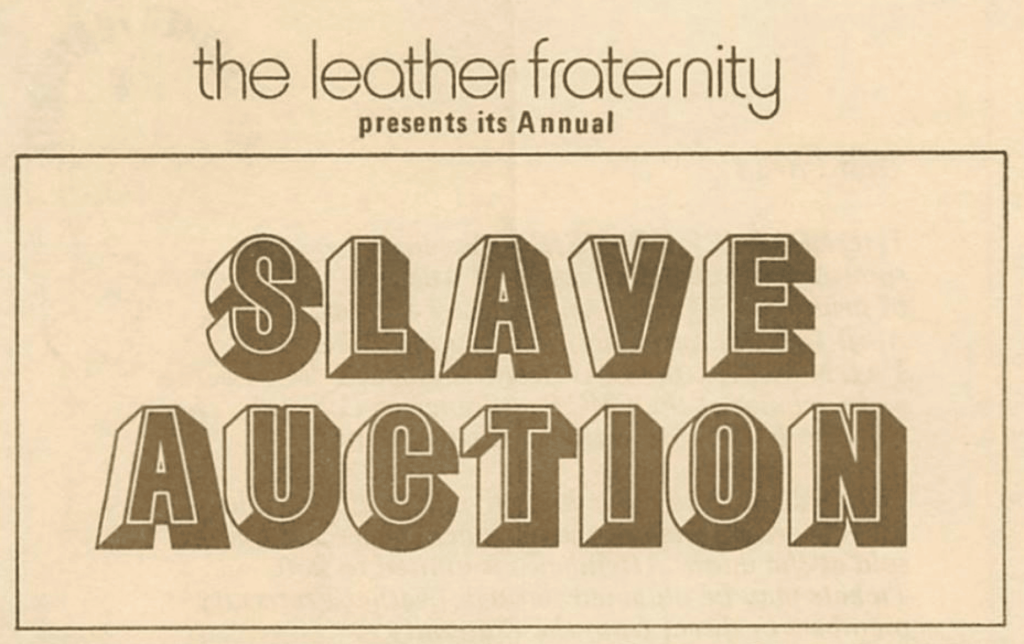
At Stonewall in 1969, gay character changed. At the founding of Drummer in 1975, leather character changed. In 1976, Los Angeles police chief Ed Davis freaked out over the empowering strength in numbers of masculine leathermen that he could no longer dismiss as “sissies” that he could manhandle. Threatened by our first five issues, he hated Drummer the way dictators hate media. On April 10, he attacked us with 65 cops, one helicopter, and one city bus to raid the festive Drummer Slave Auction fundraiser, sponsored by the Leather Fraternity. He arrested 42 people, including the entire Drummer staff. When a cop asked editor Jeanne Barney, the manager of the Leather Fraternity, if she were a drag queen, she snapped, “Honey, if I were a drag queen, I’d have bigger tits.” The police drove Drummer from disaster in L.A. to destiny in San Francisco.
DRUMMER ROOTS: THE LEATHER FRATERNITY
In the name of the Marquis de Sade, Drummer validated emerging daddies, boys, bears, and the BDSM alphabet soup of TT, CBT, and FF. Drummer prepared the way for you to be okay with the perversatility you enjoy today. Drummer was the autobiography of us all, or at least a lot of us, written and drawn and photographed by many of us to entertain the rest of us. Editing Drummer was a wild existential ride in gay pop culture, when readers demanded authenticity and leadership in reporting the coming out of BDSM identities. The cover feature for the July 1976 issue of Drummer, was “Drummer Goes to a Leather Wedding.” From 1977 to 1980, by good fortune in the snake pit of gay publishing, I’d survived editing almost half the issues in existence, and continued as a contributing writer, photographer, and consultant through 1999.Historically, Drummer grew out of four things: 1. Clark Polak’s 1960s magazine, Drum, art-directed by Al Shapiro who became my art director at Drummer; 2. Larry Townsend’s 1972 Leatherman’s Handbook based on his Kinsey-like questionnaire about leathermen; 3. The H.E.L.P. Newsletter of the Homophile Effort for Legal Protection, which was founded in 1969 to bail out men entrapped by the L.A.P.D.; and 4. The drab-gray Leather Fraternity Newsletter that needed the sex appeal of colorful pictures and hot stories to recruit members. Businessman John Embry founded that Leather Fraternity in 1974 as his mail-order scheme to sell cock rings, tit clamps, and poppers that weren’t available in Iowa. On June 20, 1975, he slick-wrapped his brochure inside his first official Drummer and trumpeted the Leather Fraternity in bold print on the covers of the first four issues.
STATISTICS: DRUMMER LAID END TO END
A stack of 214 issues of Drummer is a coffee-table sculpture 3.5 feet tall weighing 120 pounds. Laid flat, top to bottom, Drummer stretches 64 yards: two-thirds the length of a football field. At a rough 90 pages per issue, Drummer comprised a total of 20,000 pages of advocacy journalism created by hundreds of writers, artists, photographers, and designers, including thousands of hot sex ads written by subscribers. It took a village to fill Drummer. With 42,000 copies of every issue in the 1970s, and with a pass-along rate of at least a “plus-one reader” in addition to each subscriber, approximately 80,000 people handled each monthly issue—that’s 20 million people over 24 years. The annual Folsom Fair hosts 100,000 leather guests. In gay book publishing, 5,000 copies sold is a bestseller. Drummer helped invent gay publishing by serializing manuscripts that could have been books if gay book publishers had existed before the mid-1980s. More interactive than a book published once, a magazine must skate a figure eight on an ice cube to refresh its monthly connection to readers.
TOM OF FINLAND: HOMOMASCULINE REPRESENTATION
Drummer was a leatherman’s monthly handbook. For 24 years, among millions of leatherfolk in North America and Europe, there was hardly a player who had not heard of or read Drummer. Years after the internet killed original-recipe Drummer, readers continue to write fan mail to say that as teenagers they had managed to find Drummer, even in Bumfuck, Texas, and that the assertive primer that was Drummer had mentored their gender and kink identities through erotica that made them think while they were masturbating. There was political empowerment of homomasculine gender identity in our rebel rag for leatherfolk who like men to be masculine, so much so that Durk Dehner, president of the Tom of Finland Foundation, declared that “Drummer, groundbreaking for its time, set precedence for all homomasculine representation to come.”
MASTURBATION IS MAGICAL THINKING
Masturbation is magical thinking. You stroke your wand of manhood, and conjure what you want. Initially, what we did to make Drummer pulsate hard was to introduce the realism of accessible guys offering new games. We built the spank-bank fantasies of one-handed readers who wanted a virile and virilizing magazine that was a GPS of the new frontier of BDSM. Talk about interactive media! What magic it is to create words and images that make men cum. Erotic writing begins with one stroke of the pen and ends with many strokes of the penis. With its reality-TV contents, Drummer was a reader-reflexive magazine showcasing pictures of tough customers you could meet, instead of porn models paid to fake leathersex.
NOT OLD OR NEW GUARD, DRUMMER WAS AVANT-GARDE
The liberal beauty of Drummer was its social permissiveness, anchored in marching to one’s own drummer. Self-reliance was the key philosophy. Drummer was descriptive, not prescriptive, about leather behavior. Drummer was non-judgmental, simply reporting how grassroots leather lives were actually lived without commandments. Even though the Drummer voice was most often a “top” seducing subscribers who mostly liked to read S&M stories from a deliciously overpowered “bottom” point of view, it was no domineering patriarch demanding, “Thou shalt” or “Thou shalt not.” Drummer never prescribed that there was a politically correct way to live leather or be a man because, while there may be rules around sex, nobody’s sure what they are.
Drummer was never old guard or new guard; Drummer was always avant-garde. That’s why its 20th-century version still holds up as a grand power base, sustaining the new 21st-century version. Because of its passionate readers, Drummer survived 24 years of stress from bad management, censorship, plague, and the 1989 earthquake that destroyed our office — to say nothing about that one early plot twist of bad luck becoming good luck, when the L.A.P.D. busted the infant Drummer when it was only 10 months old and chased it to freedom in San Francisco. Nevertheless, we survived those dangerous pioneer days after Stonewall. And here we come again! Drummer is a living history of leatherfolk, written in human blood, tattooed on tribal skin.
WHO’D A THUNK IT!
I hope that baroque-back cowboy appreciates his Drummer collection. As the new Drummer rises, the original publication is in the permanent archives of the Kinsey Institute, the Getty Museum in Los Angeles, Cornell University’s Human Sexuality Collection, Brown University’s John Hay Library, Bowling Green University’s Center for Popular Culture Studies, the New York Public Library, the L.A. County Museum of Art, the ONE National Gay & Lesbian Archives at the University of Southern California, the Leather Archives & Museum in Chicago, and the Schwules Museum in Berlin.