










Fresh out of college (UT Austin, class of 1978), I knew I wanted to become an author, but how? I sent stories to “literary” magazines and science fiction pulps – and got polite rejections.
Then I recalled one of the seminal pieces of advice you hear in every creative writing class: write for what you read. What did I actually read? Not Sewanee Review. I read Drummer! Which I had discovered at some hole-in-the wall porn shop with glory holes on the outskirts of Austin, frequented by a mix of cowboys, truckers, and fratboys. They went there to exchange blow-jobs through the partitions, I went to buy Drummer. (Okay, I went for the blow-jobs, too.)
Through the mail, I sold my first story to Drummer editor John Rowberry in San Francisco using the pen name Aaron Travis. I later hit the bull’s-eye with a supernatural S&M tale called “Blue Light” (Drummer #44, 1981), which got lots of reader feedback and even impressed The Founder, the ever-irascible and slightly crazy John Embry.
On my first visit to San Francisco––on the only night I didn’t go to the baths––John Rowberry literally wined and dined me like I was literary royalty. Little did I know he was softening me up to eventually take over his role as fiction editor so he could concentrate on other duties at the magazine.
I was hired in 1983. On my first day working at the Drummer offices in San Francisco’s South of Market neighborhood, where all the leather and biker bars were located, Rowberry showed me to a cluttered cubby at the back of the building, pointed to a tottering tower of manuscripts, and told me my job was to plow though the slush pile. He acted like it was some onerous task but to me, this was a dream come true. I would get to read every porn story coming from every corner of the country from the readers of Drummer. My job was to read porn all day, and they actually paid me! (Well, sometimes. But that’s another story…)
All the manuscripts were hand-typed. Sometimes the pages were a bit grease-stained and slightly stuck together. If the author had gotten himself so excited that he started typing one-handed, that was a good sign.
As with every slush pile most of the stories weren’t very good, but even the worst of them possessed in-your-face authenticity. These weren’t stories cranked out by jaded professional hacks, they came from readers––many in America’s isolated backwaters who had discovered in Drummer a motherlode of fantasy and freedom they could find nowhere else, and who wanted to be part of it. They had something to say, whether or not they said it well. The style might be stilted, the plotting weak, but the feeling was 100% genuine.
Some of the stories were too poorly written to salvage, some needed just a bit of editing, some needed a lot of editing. But some of those stories—a precious handful—were so good they blew me away. And made me cum. More than once.
Before I became fiction editor, the great John Preston had already published his novel Mr. Benson in the magazine (serialized in Drummer issues #29-38), an instant classic of S&M erotica. Preston was a genuine leatherman who never left that identity behind even as he started writing and editing books for major New York publishers. Ten years older than me and living on the opposite coast, Preston was always a few steps ahead of me in the publishing game. I saw him as both rival and mentor. No writer I ever knew was more generous in helping other writers.
Preston befriended a fellow author in the big-league publishing scene who got off on Preston’s work and had a hankering to write their own S&M erotica, and eventually did so, under a pen name. This famous, best-selling author’s identity was a big secret (including to me); when E.P. Dutton offered Drummer a pre-publication excerpt, and I jumped at the chance. I made the highest offer I could, given my tiny budget, and over the phone the author’s agent kvetched a bit—“I was hoping at least she could buy a coat!”—thus revealing the famous author’s gender. I already suspected it was a woman from certain aspects of the writing. Reading and rereading the galleys of the novel looking for the best excerpt, I also began to suspect I knew who the pseudonymous “A.N. Roquelaure” was from certain stylistic quirks, notably her use of what I call the “breathless and,” as in: “And he tied my hands. And I turned. And I saw the whip.” I wrote Preston: “If I correctly guess the author’s name, will you confirm?” He wrote back and said yes. I mailed him a sheet of paper with only two words: “Anne Rice.” Preston wrote back: “Yes!”
What a coup—I had the author of Interview with the Vampire in Drummer! (The excerpt was from Beauty’s Release, Drummer #71). And I actually dared to edit out some of the author’s redundant “ands”—which makes me, I suspect, one of the few editors who ever got away with editing the notoriously prickly Anne Rice.
I also bought early work by Tim Barrus, a roman candle of a writer who wrote at a ferocious pitch (“To Have and to Hold,” Drummer #67, etc.). What a wild career he went on to have! The whole affair is too convoluted to recount here; LA Weekly dubbed it “Navahoax.” Search for the page “Nasdijj” at wikipedia, and brace yourself.
In our tenth anniversary issue I got to showcase the last work of erotica by Sam Steward, under his Phil Andros pen name (“Four on Ice,” Drummer #85). Sam was the stuff of legend, having been a college prof, friend of Gertrude Stein and Alice B. Toklas, tattoo artist, porn writer, and guinea pig for the pioneering sex researcher Alfred Kinsey. Sam became a mentor to me as well as to John Preston. His life was later recounted in a sprawling biography by Justin Spring, Secret Historian: The Life and Times of Samuel Steward, Professor, Tattoo Artist, and Sexual Renegade.
And of course there was my own S&M fiction in Drummer, under my Aaron Travis pen name. This included the serialized novel Slaves of the Empire (Drummers #53-56), in which I got to indulge my fascination with all those muscleman-in-bondage gladiator movies I watched as a boy (and still do). Slaves was not my last work of historical fiction set in ancient Rome; eventually I broke into the “legit” publishing world with a historical mystery, Roman Blood, the first in a long-running series. That happened with the help of John Preston, who connected me with the late, great, pioneering gay editor Michael Denneny at St. Martin’s Press. We called that the literary gay mafia at work.
One of the Aaron Travis stories of which I’m fondest was “Crown of Thorns” (Drummer #69), about a CIA agent in Istanbul who falls under the spell of a sadistic Turk. (The spy novels of John le Carré were a big influence on me at the time.) My fuck-buddy-cum-lifelong friend Gary kept a tattered copy of that issue of Drummer under his bed, and once confided to me that he had
read “Crown of Thorns” countless times.
“Yeah,” I beamed, “I think I did a pretty good job with that one. Especially with the ending.”
“Oh, I’ve never reached the end,” said Gary, thus giving me the highest compliment that can be paid to a writer of one-fisted fiction.
I also published early work by Lars Eighner (“Smuggler’s Moon,” Drummer #44), who I always argued wrote prose at the level of The New Yorker (if The New Yorker published gay porn). No writer was ever better at creating a moody atmosphere of yearning and lust. Lars lived in Austin, and on my frequent trips home to Texas he and I became friends. Lars and his dog Lizbeth ended up homeless for a while, the fate every struggling writer dreads. He sent me letters from the road so funny, insightful and elegantly written they blew my mind. “This is your book!” I told him. My faith was vindicated when his memoir Travels with Lizbeth (agented by me) landed on the front page of The New York Times Book Review in 1993.
When Lars died in 2022, the obit writer at the Times kindly identified Yours Truly as the “conduit” who helped bring the story of Lars and Lizbeth to light. I love that idea of being a conduit—not just for Lars, but for all the writers I got into the pages of Drummer, so that what they had to say could be shared with those who wanted very much to read it. And cum. More than once.
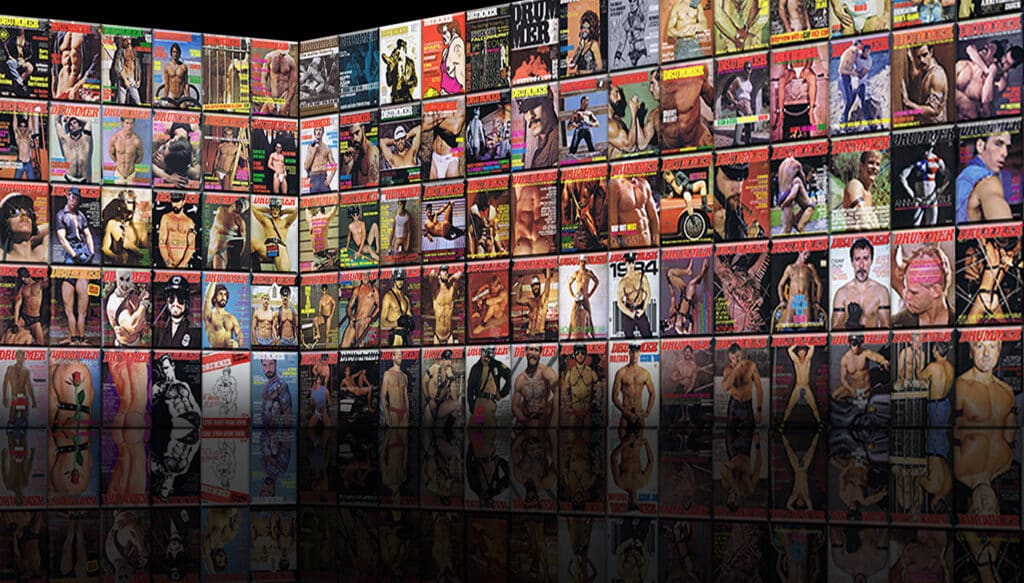
This all happened long ago, but those writers and their stories still resonate today. They’re part of Drummer’s history, but more than than, part of America’s literary history, and the worldwide history of sexual exploration and freedom.
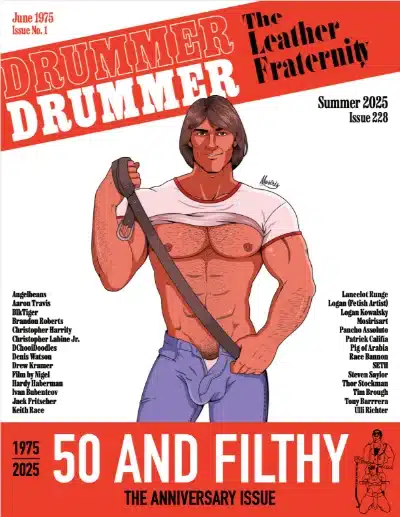
Fifty years on, what extraordinary new writers and fantastic discoveries will appear in the pages of Drummer? Keep reading!
Author: Steven Saylor (aka Aaron Travis)/p>